
“How do I make an online course more engaging?” or “how do I increase the engagement in my courses?” is something that a lot of new people who are making online courses ask me.
I know how upsetting it is to work on an online course for weeks or even months and then have most of your students drop out in the middle of it.
You’ll finally admit that your class isn’t as interesting as it could be and start looking for ways to make it better.
As an online course maker, one of your main goals should be to not only teach your subject but also give your students the best learning experience possible.
Your students will be more likely to finish your course and really understand what you are teaching if they have a better time taking it.
Students will be happier with this, and there is a better chance that they will buy another course from you in the future.
For that reason, it’s good for you and your students to learn how to make online learning fun, and you should really put in the time to accomplish this.
So how do you make an online course that people want to take?
To make an incredibly interesting and fun online lesson, do these things:
Make courses with projects
Be seen on video
Add quizzes, homework, and discussions with other students.
Set up an online group
Use a variety of content and start telling stories.
Shorten your lessons.
Let’s jump right in!
Create Project-Based Courses
Why is this tip number one? Because it’s what I’ve found to work best over the years.
The goal of project-based learning is to use problems or tasks to teach difficult skills or ideas.
Let me explain why I believe this method is so effective at increasing participation.
Since I teach software development, I started by making courses that teach things like a computer language or a software development tool, with one lesson for each feature and a short demo of that feature only.
I did notice, though, that this kind of course didn’t get many responses or interactions.
So I tried something different: I started making project-based classes that teach the same things but also let students build a small app with me from start to finish of the course.
And I saw that after that, kids were much more interested in my classes!
By the end of the courses, I was getting very specific and well-thought-out questions that I hadn’t been getting at all before.
My students learned more and interacted with each other more. By the end of the course, they had not only learned how to code but also made an app to show for it.
As soon as a student knows what they want to achieve, they are much more likely to stick with the course and finish the job.
Here is my most important piece of advice: try to make as many of your classes as possible project-based.
I think it’s important to remember that many students will still just watch the course and not work on the project, even though project-based classes are great.
They just want to watch you work on the project because they won’t have time to do it with you.
Not all students can watch the courses all the time. Some may only be able to do so a few minutes each night while lying in bed with a tablet or phone.
For students who don’t want to build the project with you as you go, you should always make sure that your course is still interesting and useful.
Show Up on Camera
There are times when you need to be on TV to teach something. People who make online courses in dance, karate, and yoga are some examples.
But most of the time, you can teach something by recording your computer screen and showing slides, pictures, or even an app that you are using. This is called a video.
That’s when you might want to avoid going on camera at all costs.
I tell you not to do it.
At the very least, I think you should be on camera sometimes.
One reason being on camera makes your course more interesting is that your students can see your body language, facial expressions, and movements, which makes them feel like they know you and your material.
Having your students be able to see you will really help them get into the course and stick with it until the end.
How Often to Show Up On Camera?
Being on camera can help you get more people to participate in your online course, but I don’t think you have to do it all the time.
If you’re like me and don’t feel 100% natural or comfortable on camera, or if your course doesn’t need you to show something in person, then you don’t have to be on camera for most of your online classes.
Since 2016, I’ve been making online courses and usually making six figures from them. I know this because I haven’t been on camera very often 😉!
How do I do it?
In fact, I wrote a whole post about it here: Should You Go Live as an Online Course Creator?
But let me quickly tell you what it’s about.
I only need to show up at the start of the course and at key places during it, like at the start and end of each section (if needed).
Most of the time, I only show up on camera again in the last lesson, where I review everything we’ve learned.
For me, this amount of camera presence is perfect. But if you’re okay with going all the way, then the more you show up, the better for engagement and building your brand.
But in my classes, I get a lot of participation with this small camera presence, so I think you should give it a try too.
I also know of a few high-paying course creators who don’t show up on any of their videos. On the other hand, many of the best instructors do show up regularly, sometimes at key parts and sometimes all the time.
Incorporate Quizzes, Assignments & Student Discussions
One of the best ways to get more out of an online school is to give quizzes and homework.
Your students will spend days, weeks, or even months watching your online course, based on how long it is.
People probably won’t finish your courses if they aren’t set up correctly to include quizzes and homework.
Aside from that, quizzes are fun and can help your students feel better about their work. A student is more likely to keep learning when they get the answer right.
Put well-thought-out quizzes at the end of each lesson or topic to get more people to participate in your online course.
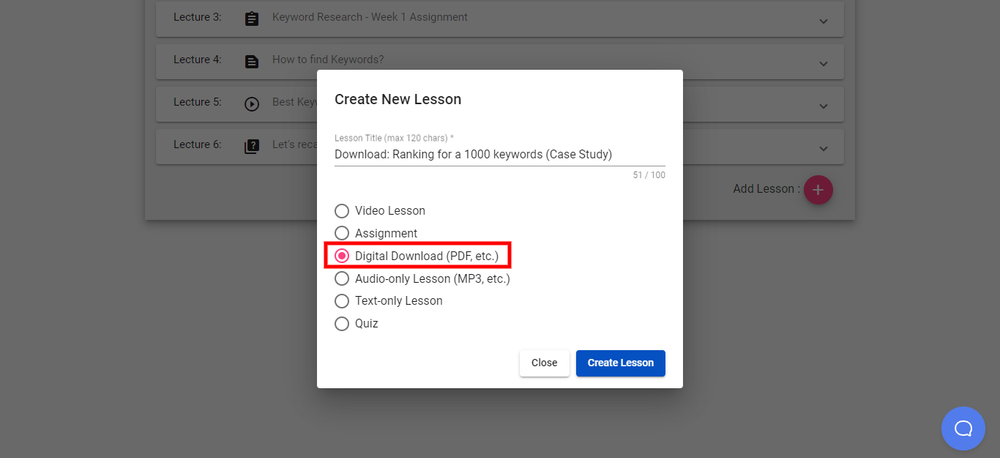
Onlinecoursehost.com is one site that lets you add as many quizzes as you want to your online course.
From the “Create lesson” tab, all you have to do is click on “Quiz” and add your questions and choices.
Introduce Storytelling
Telling your kids a story is a great way to keep them interested in their online learning!
Along with your skills, you’ll do better as a course author if you can tell good stories.
To make your point more clear, learn how to use short stories in your lessons. That will raise the level of your course.
Telling stories is just something that comes easily to people.
In his TEDx talk, Aaron Barth said the following:
“Teaching comes naturally to us because we learn best through stories.” People using human stories to teach other people. It’s how we talked and learned.”
We learn best through experience, and stories help us do that. And talking about your own stories is one way to add storytelling to your online class.
Not only will telling your students a short story about how you did something will help them learn better, but it will also make you more relatable and trustworthy in their eyes.
They will trust you more because they think you have more experience than them. They will believe this is the right path for them and keep watching it.
Don’t use any story, though. The story should be very related to the subject at hand, and it should be used to make a point.
Keep Your Lessons Short
Here is one more very important tip to help you do well in your online study.
When you’re recording a lesson, you might want to keep going and going, trying to get as much done as you can in one video.
Yes, longer movies do make the process of recording go faster for you.
Do your kids learn more from longer videos, though?
No, unfortunately not. Long lessons are one of the main reasons why students drop out of a course; it’s hard for them to stay focused for that long.
When I teach, I try to keep my lessons between 5 and 10 minutes. I record three-minute lessons sometimes and twelve- or thirteen-minute lessons other times.
I just try to stay away from long lessons because they were hard for me when I was a student.
One time, I quit a class because I was having a hard time finishing a 20-minute lesson, even after trying several times.
I even remember falling asleep more than once while trying to take a lesson that was longer than 20 minutes on my tablet in bed. I chose not to take the rest of the course in the end.
Conclusion and Next Steps
You can make a course more interesting by picking a course platform with the right tools and then using them correctly, as you can see from the tips.
Simple things you can do to make your course more interesting and satisfying are giving students quizzes and homework, pushing them to talk to each other, making courses based on projects, and filming short lessons.
So it’s very important that the site you use to host your course has all the tools you need.
If you want to make an interesting online course, all you have to do is pick the right course platform that has all the tools you need to keep students interested and use them in your course.
You have all the tools you need on the Onlinecoursehost.com site, such as:
There are different kinds of material for students to learn, such as PDFs, digital downloads, audio lessons, video lessons, rich-text lessons, and more.
Go to onlinecoursehost.com to check it out. The best thing about it is that it’s very cheap and simple to use.
We want to give you more than just a site, though. We want to give you all the information you need to make your online course business grow.